
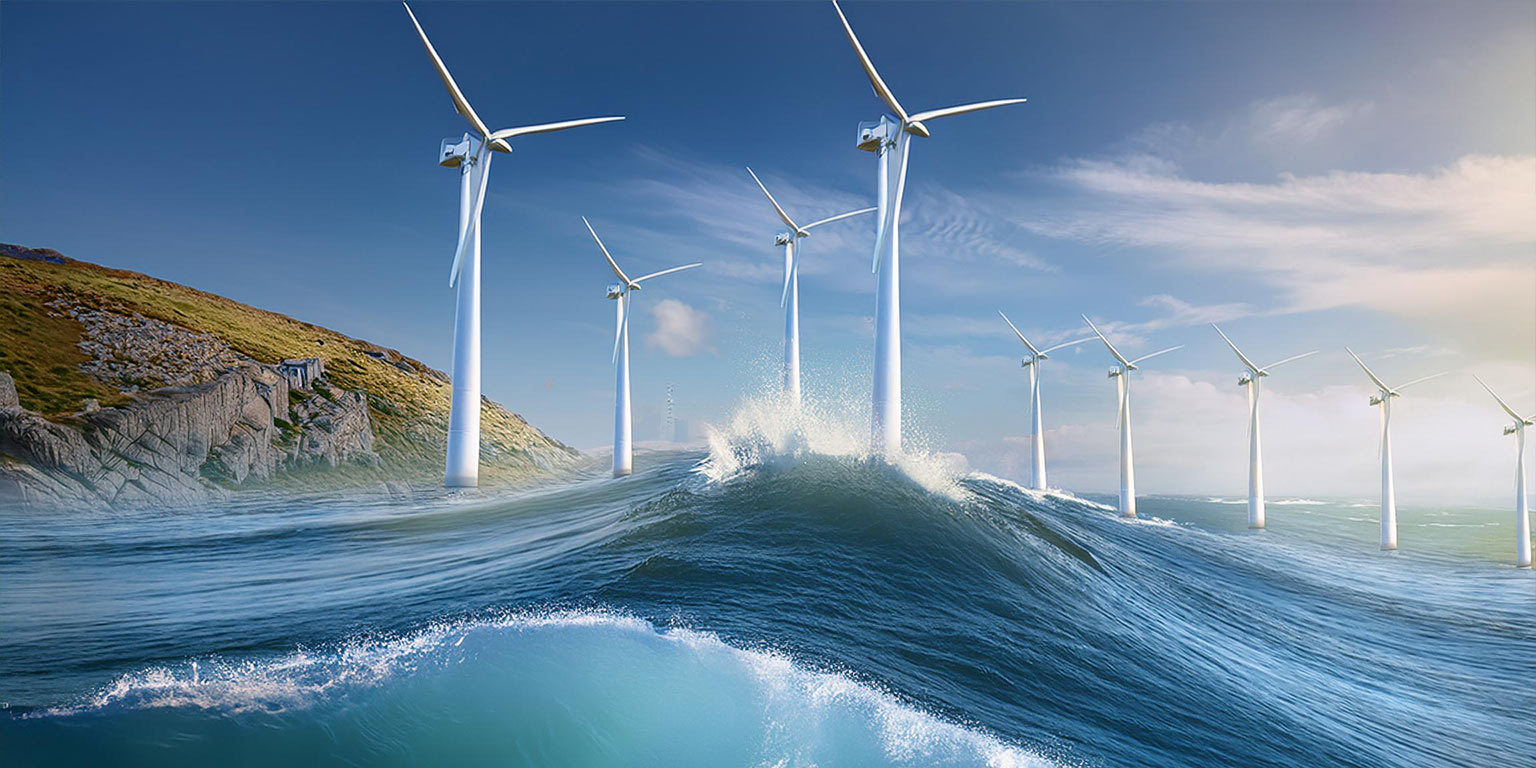
Potential of tidal and wave energy as sustainable energy sources. There is a huge potential in tidal and wave power, particularly in the provision of sustainable energy resources from marine renewable energy. More than 70 percent of Earth’s surface is covered by oceans, which carry massive amounts of kinetic energy generated through tides and waves (Khojasteh et al., 2023). Thus, harnessing these power sources would go a long way toward global energy requirements with minimal dependence on fossil fuels. Tidal energy make involves the use of gravitational forces from both the moon and sun, which exert a pull on
the oceans of Earth. The rise and fall of tides in the oceans translate into immense volumes of water moving in and out of coastal areas, thus providing a reliable source of energy. Tidal energy can be tapped with tidal turbines, much as wind turbines capture the kinetic energy of moving air. Another method is by large dam-like structures called tidal barrages, where potential energy comes from the difference in height created between high and low tides (Khojasteh et al., 2023). Wave energy is created by the flow of wind over the ocean’s surface, forming waves that carry kinetic energy in them. This energy from the waves can be recovered whenever the waves reach the ocean shore through different devices: oscillating water columns, point absorbers, and attenuators. Moreover, wave power can be more reliable than wind or solar because the energy is still maintained in ocean waves when the wind dies down or clouds cover the sun (Khojasteh et al., 2023). Both tidal and wave energies offer a number of advantages over traditional sources of energy. They emit absolutely no greenhouse gases during operation, result in very minimal carbon footprints, and can provide a consistent and reliable source of renewable energy. Tidal
energy, in particular, is extremely predictable due to the highly understood cycles in tides. The theoretical global potential of marine energy is large. Estimates show that wave energy alone may be able to supply up to 10% of global electricity consumption (Climate Action, 2017). While tidal energy is more geographically limited to regions with strong tidal flows, it can be similarly promising in specific coasts such as in the UK, Canada, and some areas in Asia (National Geographic, 2022). However, realizing its potential needs substantial investment both in technology development on the one hand and in overcoming numerous challenges. Activity: Building a model to demonstrate how tidal energy can be harnessed. The simplified activity involved the use of water from tidal oceans, a toy windmill, a plastic
tubing, a voltameter, and a stopwatch.
- Water was directly tapped using a small container as the tides runs.
- A tidal flow was then created using two different containers and a plastic tubing.
- The energy in the tidal waves of water was then measured using a voltmeter to record the potential, and a stopwatch to record time.
- The level of the flow and the water level were then measured to determine the precise measurements of the tidal energy generated from the waters. Future: Reduction in fossil fuel dependence, sustainable coastal communities The future for tidal and wave energies is based on the reduction in dependence on fossil fuels and sustainable living of coastal communities. Tidal and wave powers are two renewable sources that will play a crucial role in the global energy transition, with the increasing global energy demand due to the different adverse impacts of climate change. Marine energy is one of the significant advantages in being consistent and reliable, whereas solar and wind power are too intermittent. Tidal and wave energy can provide local energy generation to coastal communities, decreasing reliance on imported fossil fuels and dependence on centralized power networks. Development: Investment in marine energy technologies, addressing environmental impacts
Increased investment in research and development is necessary to achieve the full potential of marine energy. Technologically, innovation will be needed to develop appropriate, more effective, affordable, and reproducible tidal and wave energy conversion systems. Among the technological challenges, high investment costs in the installation and maintenance of marine energy infrastructures are some of the major ones. While solar and wind have benefited from cost reductions associated with technological improvements and mass production, marine production of energy requires further technological development for economic viability. Future: Reduction in fossil fuel dependence, minimal carbon footprint
The reduction of overreliance on fossil fuels in the production of energy is a step in the reduction of carbon footprints. Increasing the use of marine renewable energy sources, particularly tidal and wave energy, can reduce dependence on fossil fuel resources and minimize the carbon footprint. As opposed to the other renewables, these two forms of energy are highly reliable and have minimal effects. Increased innovations in improvement in marine energies and reduced costs are important in achieving energy demand in coastal regions and could thus also decrease dependency on carbon-extensive energy source supplies such as coal, oil, and natural gas. The wave energy conversion is a significant pathway toward harnessing the ocean’s potential for an essentially sustainable energy future with minimal greenhouse gas emissions. Challenges: High initial costs and potential impacts on marine habitats Despite the high potential of tidal and wave energy, there are still developmental challenges. Ideally, the costs associated with systems of marine energy make it disincentive for full adoption. Tidal barrages and underwater turbines are capital-intensive to construct and layout. Further, operation expenses are relatively high since these systems have to be maintained in a marine environment characterized by the high exposure of equipment surface to saltwater corrosion coupled with strong currents and storms. Besides this, the energy systems damage marine habitats. In practice, the tidal energy systems affect the barrages, causing disturbances in the natural flow of water, which, in turn, may affect sediment transport, water quality, and
migration routes of marine life. Fish and marine mammals are severely affected, and their populations are reduced significantly. Thus, it would be imperative to conduct rigorous environmental impact assessments and engineering of all technologies that would have minimal disturbance to marine ecosystems.
References
Climate Action. (2017). Wave power’s share of global electricity demand to reach 10% by 2050
- Climate Action. Climateaction.org. https://www.climateaction.org/news/wave-powers-
share-of-global-electricity-demand-to-reach-10-by-2050
Khojasteh, D., Abbas Shamsipour, Huang, L., Tavakoli, S., Haghani, M., Francois Flocard,
Farzadkhoo, M., Iglesias, G., Hemer, M., Lewis, M., Neill, S. P., Bernitsas, M. M., &
Glamore, W. (2023). A large-scale review of wave and tidal energy research over the last
20 years. Ocean Engineering, 282, 114995–114995.
https://doi.org/10.1016/j.oceaneng.2023.114995
National Geographic. (2022, May 20). tidal energy | National Geographic Society.
Education.nationalgeographic.org; National Geographic.
https://education.nationalgeographic.org/resource/tidal-energy/